Draycott 8 is distinguished by more than its District 10 address and spacious residences.
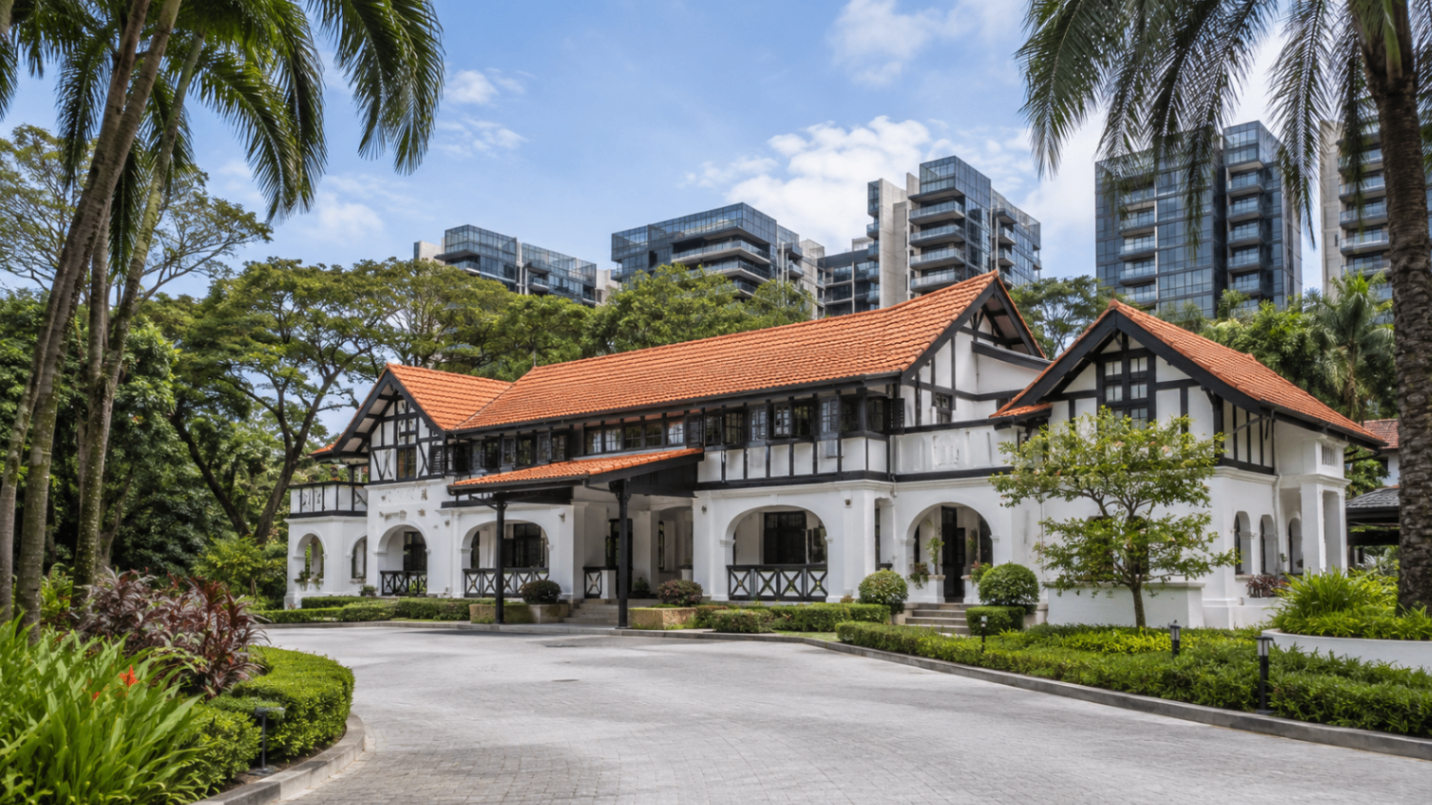
At the heart of the estate is a restored black-and-white building dating from the 1920s, retained and adapted as the development’s heritage clubhouse.
Rather than creating a new clubhouse designed to imitate an older architectural style, Draycott 8 incorporates an authentic surviving structure into the residential environment.
This gives the estate a sense of history, arrival and identity that is difficult to reproduce through contemporary design alone.
This guide explores the role of the heritage clubhouse, why its conservation matters, how it contributes to daily residential life and what buyers should examine when considering a home at Draycott 8.
Explore Draycott 8
Speak with The Janys to review the latest information for Draycott 8 Heritage Clubhouse Guide.
The Draycott 8 Clubhouse at a Glance
The clubhouse is one of the defining features of Draycott 8.
What Is a Black-and-White Building?
Singapore’s black-and-white buildings are recognised for their strong contrast, shaded verandas, pitched roofs and design responses to the tropical climate.
The term refers to an architectural style rather than a single standard building type.
Different examples may vary in scale, layout, history and original use.
At Draycott 8, the retained building contributes authentic architectural character to the estate.
Its importance does not come simply from a black-and-white colour scheme.
It comes from the fact that an existing historic structure was conserved and integrated into a modern residential development.
This distinction matters.
A new building can borrow visual motifs from the past. A conserved structure carries physical continuity with an earlier period of Singapore’s built environment.
Do not add a detailed general history of colonial architecture unless it is supported by verified project material and directly relevant to Draycott 8.
Authentic Heritage Rather Than Decorative Imitation
Many modern developments use design references to create a particular atmosphere.
They may incorporate classical proportions, colonial-style details or heritage-inspired interiors.
Draycott 8’s clubhouse is different because the development retained an existing black-and-white structure.
The value of that decision lies in authenticity.
The building’s age, form and physical presence existed before the surrounding modern residential environment.
Its conservation allows the estate to retain a tangible connection to the site’s earlier architectural character.
For buyers, this can create a stronger sense of place than a clubhouse designed entirely as a new decorative concept.
The result is not simply an amenity building.
It becomes part of the identity of Draycott 8.
Why Conserving the Clubhouse Matters
Conservation within a private development requires the project to work with an existing structure rather than treating the site as a completely blank canvas.
This may involve balancing:
- Heritage character
- Structural requirements
- Modern services
- Resident use
- Safety
- Accessibility
- Maintenance
- Landscape integration
- New residential construction
The preserved clubhouse demonstrates that an existing building can remain relevant within a contemporary estate when it is thoughtfully integrated into the larger development.
Its conservation matters because it:
- Retains a visible part of the site’s architectural history
- Gives the development a distinctive focal point
- Provides contrast between old and new
- Creates a more memorable sense of arrival
- Adds character to the shared environment
- Prevents the estate from feeling interchangeable with other condominiums
- Gives residents a physical connection to an earlier period of the area
Do not describe specific restoration techniques unless they are verified in approved source material.
URA Architectural Heritage Awards 2006
Draycott 8 received recognition at the URA Architectural Heritage Awards 2006.
The recognition is relevant because it connects the development’s conservation approach with Singapore’s wider architectural-heritage framework.
For buyers, the award should not be treated merely as a decorative badge.
Its significance lies in what it represents:
- Recognition of conservation effort
- Retention of heritage character
- Integration of an existing structure into a new residential development
- Continued use of the building
- Contribution to the identity of the estate
Use the exact approved award wording already present within the Draycott 8 project.
Do not:
- Invent a different award category
- Invent judging comments
- Invent a citation
- Invent additional heritage awards
- Claim that the award guarantees future value
- Claim that the building is a national monument unless verified
Where Heritage Architecture Meets Modern Residential Living
The clubhouse creates a visual and experiential contrast with the surrounding residential blocks.
The restored building reflects an earlier architectural period, while the apartments and estate facilities support contemporary condominium living.
This relationship between old and new gives Draycott 8 a distinctive character.
Residents experience:
- A heritage focal point within a modern estate
- Shared spaces with architectural personality
- A clubhouse environment different from a standard function pavilion
- Mature residential surroundings
- Facilities integrated around an established identity
- A sense of arrival shaped by more than a tower façade
The success of this relationship depends on how the clubhouse, landscaping, facilities and residential buildings work together as one estate.
A buyer should therefore view the clubhouse as part of the complete development rather than as an isolated historical object.
A Visual and Social Focal Point
A clubhouse often acts as the shared centre of a condominium.
At Draycott 8, the heritage building gives that role greater visual significance.
Its architecture helps establish the tone of the estate and provides residents and visitors with a recognisable landmark.
As a focal point, the clubhouse may contribute to:
- Arrival experience
- Orientation within the estate
- Resident gatherings
- Private functions
- Informal social interaction
- Shared amenity use
- Views from surrounding areas
- The identity of the development
The exact use of individual rooms and spaces must follow the current verified estate information and management rules.
Do not invent named rooms, booking capacities, operating hours or private-event services.
How the Clubhouse Contributes to Resident Life
The value of a clubhouse is not limited to how it appears in photographs.
Its relevance depends on how it supports residents’ actual routines.
Depending on the verified facilities and current management arrangements, residents may use the clubhouse environment for:
- Informal gatherings
- Private events
- Meetings
- Quiet shared use
- Entertaining guests
- Access to adjoining facilities
- Time spent within a distinctive common environment
Buyers should consider:
- How frequently they expect to use shared spaces
- Whether clubhouse rooms require booking
- Whether charges or rules apply
- How the spaces relate to the pool, gym or landscaping
- Whether the atmosphere suits their household
- How the clubhouse affects the estate’s overall sense of community
Do not promise access to a particular room or facility unless it is verified and currently available to residents.
The Clubhouse and the Sense of Arrival
The first impression of a residential development begins before entering the apartment.
The route through the estate, landscaping, architectural focal points and relationship between buildings all contribute to the arrival experience.
At Draycott 8, the heritage clubhouse introduces a layer of character that differs from a purely modern entrance sequence.
Its presence can make the estate feel:
- More established
- More recognisable
- Less generic
- Connected to the history of the site
- Architecturally layered
- Visually distinct from surrounding developments
Buyers should experience this in person.
Photographs can show the building, but they cannot fully communicate:
- Scale
- Movement through the estate
- Landscape relationships
- Materials
- Shade
- Sound
- Privacy
- How the building feels at different times of day
Architectural Character Shaped by the Tropical Climate
Black-and-white architecture is commonly associated with design responses suited to Singapore’s tropical environment.
Features may include shaded openings, pitched roofs, deep overhangs and transitions between indoor and outdoor space.
At Draycott 8, buyers should focus on the verified features visible within the actual clubhouse rather than assuming that every characteristic associated with black-and-white houses is present.
During a viewing, observe:
- Roof form
- Shaded exterior areas
- Openings
- Verandas where present
- Relationship to greenery
- Natural ventilation
- Material character
- Internal-to-external transitions
- The way light enters the building
- How the structure sits within the estate
Do not add architectural terminology that cannot be confirmed from approved project information or imagery.
Heritage That Remains in Active Use
A conserved building can be displayed as an object, or it can remain part of everyday life.
At Draycott 8, the clubhouse continues to serve a practical role within the residential estate.
This active use matters because it allows the building to remain connected to the people who live around it.
Rather than being separated from the development, it contributes to:
- Shared resident activity
- The visual identity of the estate
- Common facilities
- Social spaces
- The relationship between landscaping and architecture
- The experience of moving through Draycott 8
The clubhouse is therefore both a heritage feature and a functioning part of the condominium environment.
How the Heritage Clubhouse Differs From a Conventional Condo Clubhouse
A conventional modern clubhouse may be designed around contemporary function rooms, glass façades, lounges and recreational facilities.
Draycott 8 offers a different experience.
Its clubhouse begins with an existing heritage structure rather than a completely new architectural concept.
This can create differences in:
- Atmosphere
- Room character
- Material experience
- Relationship to the landscape
- Sense of history
- Visual identity
- The way residents entertain guests
- The feeling of the shared estate environment
A buyer should not assume that heritage automatically means better.
Some buyers may prefer a completely modern clubhouse with newer architectural expression.
Others may place greater value on authenticity, character and a development with a strong sense of place.
The decision depends on the buyer’s priorities.
The Clubhouse Is Important, but It Is Not the Entire Purchase Decision
The clubhouse may be one of Draycott 8’s defining features, but buyers should still evaluate the complete property decision.
The quality of the purchase depends on factors including:
- The actual apartment
- Floor level
- Stack
- Facing
- View
- Internal condition
- Layout
- Renovation requirement
- Asking price
- Price per square foot
- Remaining lease
- Maintenance costs
- Facilities
- Household needs
- Intended holding period
A visually distinctive clubhouse should not distract from careful unit-level due diligence.
The strongest purchase is the home that combines a suitable apartment with the broader estate qualities the buyer values.
What to Examine During a Clubhouse and Estate Viewing
A private viewing of Draycott 8 should include more than the apartment.
Buyers should also spend time understanding the clubhouse and wider estate environment.
Clubhouse viewing checklist. - Exterior condition
- Roofline and architectural form
- Relationship to surrounding residences
- Landscaping
- Entrance
- Shared spaces
- Natural light
- Ventilation
- Maintenance condition
- Accessibility
- Connection to the pool or other facilities
- Privacy
- Resident-use arrangements
- Booking requirements
- Management rules
- Noise during active use
- Evening atmosphere where relevant
- Views toward and from the clubhouse
Estate viewing checklist. - Arrival route
- Security
- Drop-off
- Lift access
- Movement between the apartment and clubhouse
- Landscaping
- Pool relationship
- Gym location
- Shared-space condition
- General maintenance
- Visitor experience
- Privacy around residential areas
Do not represent management rules, booking charges or operating hours unless they are currently verified.
Questions Buyers May Ask About the Clubhouse
Before making a purchase decision, buyers may wish to confirm:
- Which clubhouse spaces are available to residents?
- Do any spaces require advance booking?
- Are booking fees or deposits applicable?
- Are private functions permitted?
- What are the operating hours?
- Are guests allowed?
- Are there restrictions on food, music or event use?
- How are the heritage areas maintained?
- Are any sections restricted?
- How does the clubhouse connect to the other facilities?
- Are there future maintenance plans?
- What management rules apply?
- How frequently are the spaces used?
- Can the clubhouse be viewed during the private appointment?
These questions should be answered using current estate information.
Do not pre-fill answers that have not been verified.
Heritage Character Also Requires Ongoing Care
A conserved building contributes character, but it also requires continued maintenance.
Buyers should understand that heritage architecture may involve different maintenance considerations from a newly constructed standard clubhouse.
Relevant questions may include:
- How the building is maintained
- Whether specialist work is required
- How maintenance is funded
- Whether major works are planned
- How shared-property costs are allocated
- Whether conservation requirements affect future alterations
- How the structure is inspected
- How modern services are integrated
These questions should be directed to the relevant management, legal or technical professionals where appropriate.
The article must not speculate about maintenance costs or future expenditure.
Do not imply that heritage maintenance is necessarily excessive or insignificant.
Does the Heritage Clubhouse Affect Property Value?
The clubhouse can contribute to Draycott 8’s identity and buyer appeal.
However, its presence should not be translated into a guaranteed financial premium.
Property value depends on many factors, including:
- Location
- Tenure
- Remaining lease
- Apartment size
- Layout
- Condition
- Floor level
- View
- Asking price
- Recent transactions
- Market conditions
- Competing supply
- Buyer demand
- Maintenance
- Holding period
The clubhouse may make the development more memorable and attractive to certain buyers.
Others may prioritise tenure, newer facilities or a different apartment configuration.
Do not claim that the heritage clubhouse guarantees:
- Capital appreciation
- Higher resale prices
- Faster sales
- Higher rental yield
- Permanent buyer demand
- Protection from market cycles
Which Buyers May Appreciate the Heritage Clubhouse?
Buyers who value architectural character. The preserved building may appeal to those who prefer authentic historical architecture over themed modern design.
Buyers who entertain guests. Shared spaces with a distinctive atmosphere may be relevant to residents who value hosting and social use.
Buyers who want an estate with identity. The clubhouse gives Draycott 8 a recognisable focal point and separates it visually from more conventional condominium environments.
Buyers drawn to established neighbourhoods. The heritage feature may complement the wider appeal of Draycott Park, Ardmore, Orchard and Tanglin.
Buyers considering long-term own stay. Residents planning to occupy the property for many years may place greater value on how the complete estate feels, not only the apartment interior.
Buyers who prioritise modern facilities alone. Some buyers may prefer a newly built clubhouse with a more contemporary design language.
The article should present this as a legitimate preference rather than implying that heritage is universally superior.
---
The Wider Draycott 8 Residential Experience
The heritage clubhouse is one part of Draycott 8’s broader proposition.
The development also offers:
- A prime District 10 location
- Access to Orchard, Ardmore and Tanglin
- Spacious private residences
- A contained estate environment
- Recreational facilities
- Landscaping
- Security
- Residential privacy
- A completed development that buyers can inspect directly
Buyers should therefore consider how the clubhouse works together with:
- The apartment
- The available unit’s view
- The floor plan
- The internal condition
- The estate facilities
- The remaining lease
- The asking-price position
- The intended holding period
Heritage Character or Freehold Simplicity?
Buyers considering homes around Draycott Park may compare Draycott 8 with The Draycott.
Draycott 8 offers:
- 99-year leasehold tenure
- A restored heritage clubhouse
- A strong shared-estate identity
- Spacious residences
- Established facilities
The Draycott offers:
- Freehold tenure
- Large-format apartment living
- A different estate character
- A strong emphasis on residential space and long-term ownership
- Its own selection of distinctive layouts
Neither proposition is automatically better.
The choice depends on:
- Tenure preference
- Budget
- Remaining lease
- Required space
- Facilities
- Heritage appeal
- Unit condition
- View
- Layout
- Intended holding period
- Current availability
How to View the Clubhouse When Considering a Unit
Access to the clubhouse and other shared areas should be coordinated as part of the private viewing where possible.
Buyers should confirm:
- Which facilities can be viewed
- Whether resident areas have access restrictions
- Whether the clubhouse is in use during the appointment
- Whether specific rooms require prior arrangement
- Whether photography is permitted
- Whether management rules limit access
- Whether the selected unit has a particular outlook toward the clubhouse
- How the apartment relates to the shared facilities
A viewing should be planned around both the apartment and the wider estate.
The objective is to understand whether the complete Draycott 8 environment suits the buyer’s needs.
Experience Draycott 8 With The Janys
The clubhouse is best understood as part of the complete Draycott 8 viewing experience.
The Janys assist buyers with:
- Current verified unit availability
- Private viewing coordination
- Apartment comparison
- Floor-plan review
- Stack and facing information
- View and condition comparison
- Heritage-clubhouse context
- Facility overview
- Asking-price context
- Relevant transaction information
- Remaining-lease considerations
The objective is to help buyers understand how the available apartment and the wider estate work together before progressing further.
A Clubhouse That Gives Draycott 8 Its Identity
Draycott 8’s heritage clubhouse is more than a decorative feature.
The restored 1920s black-and-white building gives the estate a physical connection to an earlier period of Singapore’s architecture while continuing to serve a role within a modern residential environment.
Its presence contributes to the arrival experience, shared facilities, visual character and sense of place.
For buyers who value architectural authenticity and a development with a distinctive identity, the clubhouse may be an important part of Draycott 8’s appeal.
The final decision should still be based on the complete property position—including the apartment, floor level, layout, view, condition, asking price, remaining lease and intended holding period.
Speak with The Janys to review the current available homes and experience the clubhouse during a private viewing.
All information is for general marketing purposes only and should be verified before making any property decision. Availability, prices, PSF, floor plans, transaction data, tax rates, financing rates, school information, amenities, and viewing arrangements may change. Please contact The Janys for the latest confirmed information.