The Draycott Transaction History at a Glance
The current market picture should use verified completed sale records and remain clearly separated from active asking prices.
Dynamic completed-sale summary. Where the central transaction source supports it, display:
- Latest verified completed transaction
- Latest verified transaction date
- Latest verified sale price
- Latest verified transacted PSF
- Verified floor area
- Transaction range over the selected period
- Median PSF over the selected period
- Average PSF over the selected period
- Highest verified PSF over the selected period
- Lowest verified PSF over the selected period
- Number of verified transactions in the period
- Date last updated
Separate active-listing summary. Where approved active-listing data exists, display separately:
- Current verified asking-price range
- Current verified asking-PSF range
- Number of approved publicly available units
- Date last verified
Required safeguards. - Completed transactions and active asking prices must be visually separated.
- Do not label an asking price as a transaction.
- Do not mix rental records into sale-transaction PSF.
- Do not show duplicate transaction records.
- Do not show unverified portal data as official history.
- Do not display a statistic without its date range.
- Do not calculate a median or average from unverified records.
- Do not show a blank or broken data block.
- Do not hard-code the values into the article copy.
- Do not display zero when data is missing.
Fallback state. If verified live data is unavailable, show:
What Does PSF Mean?
PSF means price per square foot.
It is calculated by dividing the verified transaction price by the verified floor area.
The figure helps buyers compare property prices relative to size.
However, PSF does not explain:
- Floor level
- Stack
- Facing
- View
- Privacy
- Layout
- Internal condition
- Renovation quality
- Transaction date
- Seller timeline
- Property-specific defects
- Whether the transaction involved unusual circumstances
PSF is therefore a comparison tool rather than a complete valuation conclusion.
Where the article displays calculated PSF, the sale price and floor area must both come from verified records.
Why PSF Can Be Misleading When Used Alone
Two apartments with similar floor areas can deserve different prices.
One may sit on a higher floor with a more open outlook and stronger internal condition.
Another may require extensive renovation or occupy a different stack.
A lower PSF may reflect:
- Larger floor area
- Older condition
- Greater renovation requirements
- Lower floor
- Different view
- Less-preferred orientation
- A seller’s specific timeline
- A historic transaction completed under different market conditions
- A distinctive layout with fewer direct comparables
A higher PSF may reflect:
- Stronger internal condition
- Recent renovation
- Higher floor
- Preferred stack
- Better view
- Greater privacy
- Reduced immediate renovation work
- Limited competing availability
- A more recent transaction
The important question is why the PSF differs.
Asking Price Is Not a Completed Transaction
An asking price represents the seller’s current position.
A completed transaction records the price at which a buyer and seller previously reached agreement.
The two figures must remain separate.
A current asking price may be:
- Above a recent completed transaction
- Below an older completed transaction
- Influenced by renovation quality
- Influenced by floor level
- Influenced by view
- Influenced by layout
- Revised during the marketing period
- Adjusted according to competing units
- Affected by the seller’s preferred timeline
- Subject to negotiation
A buyer should compare the asking price with relevant completed sales, but the difference must be explained through the actual unit.
Do not present asking-price data inside the completed-transaction table.
Why the Transaction Date Matters
A sale completed several years ago may provide useful historical context without directly representing the current market.
Market conditions can change because of:
- Interest rates
- Buyer demand
- Available supply
- Government measures
- Financing conditions
- Economic confidence
- Competing developments
- Rental-market conditions
- Renovation changes
- Seller expectations
- Broader District 10 activity
Recent transactions are generally more relevant to current asking-price analysis.
Older records may still help buyers understand:
- Historical entry levels
- Long-term transaction patterns
- Previous market cycles
- Transaction frequency
- Relative movement between unit profiles
- How earlier buyers positioned their purchases
Every displayed transaction must include a visible completion date.
How Unit Size Affects PSF
Larger apartments often transact at a different PSF from smaller apartments.
The total purchase price increases as floor area increases, but the market may not assign the same value to every additional square foot.
This can mean:
- A larger apartment records a lower PSF but a higher total price.
- A smaller apartment records a higher PSF but requires a lower total quantum.
- A distinctive large-format layout attracts buyers prioritising space.
- Different unit sizes appeal to different buyer groups.
Buyers should compare The Draycott transactions within genuinely similar floor-area ranges where possible.
A large-format apartment should not be compared mechanically with a substantially smaller unit without considering:
- Total quantum
- Layout
- Floor level
- View
- Condition
- Bedroom profile
- Renovation requirement
How Floor Level May Affect Transaction Price
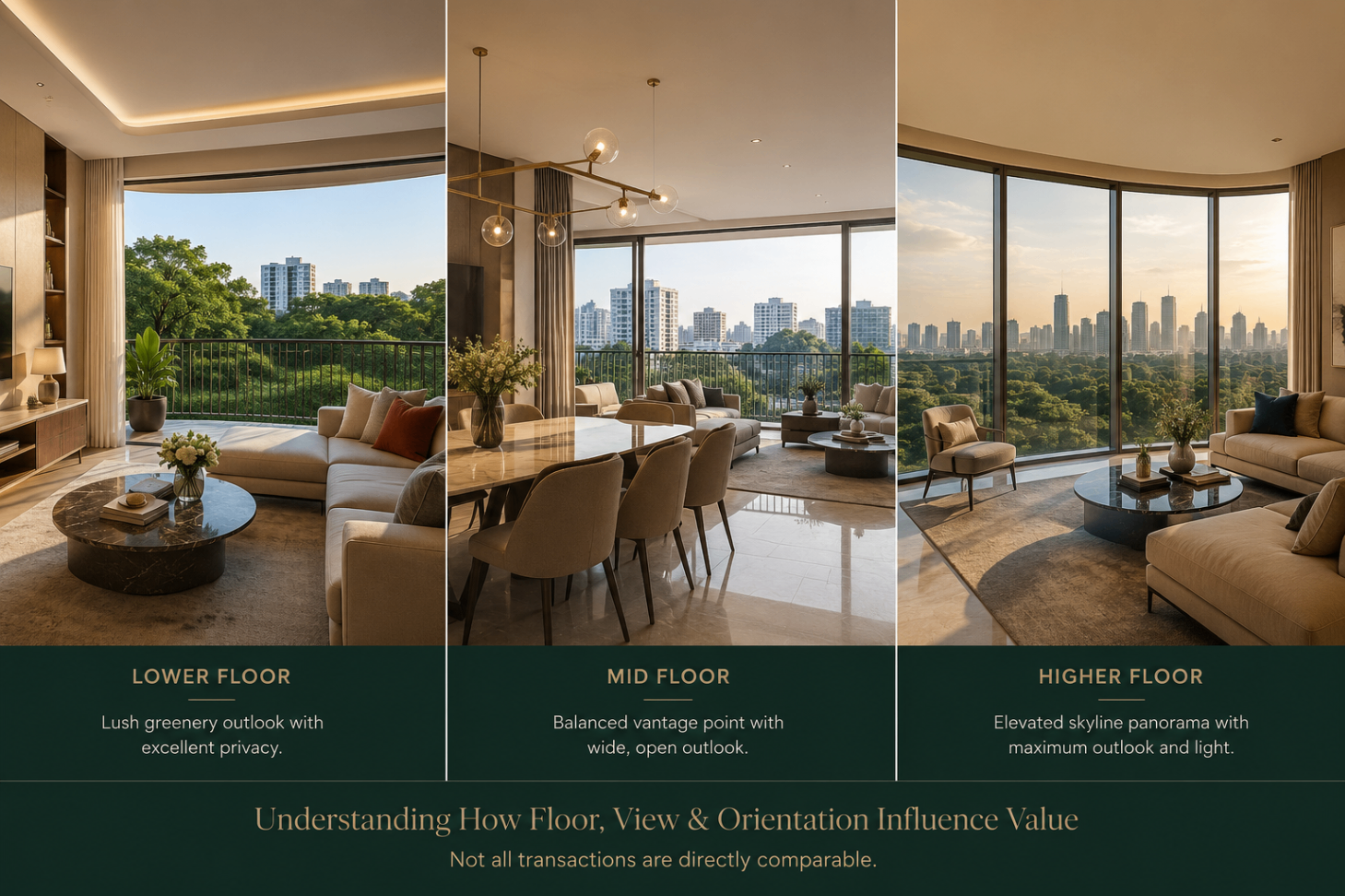
Floor level may influence:
- View
- Privacy
- Natural light
- Relationship to nearby buildings
- Road exposure
- Lift travel
- Noise
- Buyer preference
- Asking-price position
Higher floors may command a different price where they provide a stronger outlook or greater privacy.
Higher is not automatically better.
A lower or mid-floor apartment may offer:
- A preferred estate relationship
- A different connection to landscaping
- Easier access preferences
- A lower total entry position
- A view that suits the buyer more closely
Floor level should always be considered together with stack and facing.
Why Stack, Facing and Orientation Matter
The stack determines how the apartment sits within The Draycott and what its principal rooms face.
This may affect:
- Morning light
- Afternoon-sun exposure
- Privacy
- Distance from neighbouring buildings
- Road exposure
- Greenery
- City outlook
- Natural light
- Ventilation
- Noise
- Views from the living room
- Views from bedrooms
A transaction from one stack should not be treated as a direct comparison for another without understanding these differences.
Buyers should ask:
- Do the living rooms face the same direction?
- Are the bedroom views comparable?
- Are the floor levels similar?
- Is privacy similar?
- Does one unit receive stronger afternoon sun?
- Does one stack have a more open outlook?
- Are surrounding buildings relevant?
How View and Privacy Affect the Comparison
View quality is not fully captured by PSF.
A buyer may place additional value on:
- Open skyline outlook
- Greenery
- Greater privacy
- Reduced visibility from surrounding residences
- High-floor separation
- Views from multiple rooms
- Night outlook
- Natural light
Another buyer may prioritise:
- Lower floor
- Less heat exposure
- Easier access
- Closer visual connection to the estate
- A lower total purchase quantum
The view should be assessed from:
- Living room
- Dining area
- Main bedroom
- Secondary bedrooms
- Seated positions
- Different times of day
Do not rely exclusively on marketing photographs.
Internal Condition Can Explain Significant Price Differences
Apartments within an established development may vary considerably in condition.
One home may have undergone a recent renovation.
Another may retain an older interior and require extensive work.
Buyers should examine:
- Flooring
- Carpentry
- Kitchen
- Bathrooms
- Air-conditioning
- Electrical systems
- Plumbing
- Windows and doors
- Built-in storage
- Appliances
- Signs of leakage
- General maintenance
- Renovation age
- Workmanship
- Whether the design suits the buyer
The most useful comparison considers:
> Purchase price plus the likely renovation requirement.
Do not publish an unverified renovation estimate as fact.
Layout Can Affect Value Even When Floor Areas Are Similar
Two apartments with similar floor areas may use their space differently.
Buyers should compare:
- Entrance and foyer
- Living-room width
- Dining-area position
- Bedroom distribution
- Main-suite privacy
- Bathroom access
- Kitchen
- Service areas
- Study or flexible rooms
- Storage
- Circulation
- Furniture placement
- Natural light
- Views
A more suitable layout may justify a different price for a particular household.
The strongest layout depends on the buyer’s needs rather than a universal ranking.
How The Draycott’s Freehold Tenure Affects the Analysis
The Draycott is a freehold residential development.
Freehold tenure can be an important consideration for buyers assessing:
- Long-term ownership
- Estate planning
- Holding period
- Future buyer audience
- Comparison with leasehold alternatives
- Renovation commitment
- Intergenerational ownership
However, freehold tenure does not automatically determine the correct price.
Buyers should still consider:
- Floor area
- Layout
- Condition
- Floor level
- View
- Privacy
- Facilities
- Asking price
- Relevant transactions
- Maintenance
- Holding costs
- Competing developments
A freehold apartment with an unsuitable layout or excessive asking price may not be the strongest purchase for a particular buyer.
Comparing Freehold and Leasehold Transactions
Buyers may compare The Draycott with leasehold developments in the wider Orchard and District 10 market.
A direct PSF comparison should account for:
- Tenure
- Remaining lease
- Completion year
- Unit size
- Layout
- Condition
- Facilities
- View
- Development scale
- Maintenance
- Transaction date
- Total purchase quantum
A leasehold property may offer:
- A lower entry position
- Different facilities
- A newer internal condition
- A different estate character
A freehold property may appeal to buyers prioritising:
- Long-term ownership
- Tenure simplicity
- Intergenerational holding
- Reduced lease-decay concerns
The development with the lower PSF is not automatically the better purchase.
How to Compare Maisonette Transactions
A maisonette uses an internal split-level residential format.
Its transaction analysis may differ from a standard single-level apartment because of:
- Internal stairs
- Separation between levels
- Bedroom distribution
- Accessibility
- Renovation complexity
- Buyer audience
- Layout rarity
- Total floor area
- Household suitability
A standard apartment with a similar floor area may not be a direct comparable.
Where Unit 40A or another verified maisonette is being assessed, buyers may need to review:
- Similar maisonette transactions
- Large-format single-level transactions
- Distinctive-layout transactions
- Relevant District 10 maisonette alternatives
- Current competing homes
Do not assume rarity automatically justifies a premium.
How to Compare Penthouse Transactions
A penthouse may have fewer direct comparables because its floor position, layout, views and outdoor areas can differ from standard apartments.
Relevant comparison factors include:
- Top-floor position
- Floor area
- Number of internal levels
- View
- Facing
- Outdoor areas where verified
- Accessibility
- Roof exposure
- Waterproofing
- Internal condition
- Renovation requirement
- Total purchase quantum
- Transaction date
Where no direct penthouse comparable exists, the analysis may use:
- Other The Draycott penthouse transactions
- Large-format high-floor apartments
- Maisonette or distinctive-layout sales
- Comparable District 10 penthouses
- Current competing properties
Do not force an artificial comparison between materially different residences.
What Transaction Frequency Can Tell Buyers
The number of completed transactions within a development provides useful context.
A lower transaction count may reflect:
- Owners holding for longer periods
- Limited available supply
- Buyer selectiveness
- Seller expectations
- A period with fewer suitable listings
- A smaller pool of relevant unit types
- Market conditions
A higher transaction count may reflect:
- More active listings
- Greater buyer activity
- More varied unit conditions
- Changing owner profiles
- A period of stronger market turnover
Transaction frequency should not automatically be interpreted as positive or negative.
Buyers should examine:
- Time period
- Number of records
- Unit sizes involved
- Layouts involved
- Price range
- PSF range
- Whether a small number of unusual sales affected the summary
Transaction summaries may use different statistical measures.
Median PSF. The median is the middle PSF when verified transactions are ordered from lowest to highest.
It may be useful where a small number of unusually high or low transactions would distort the average.
Average PSF. The average adds the verified PSF figures and divides the total by the number of records.
It can be influenced by unusually high or low sales.
PSF range. The range shows the lowest and highest verified PSF within the selected period.
It helps demonstrate how much variation exists between transactions.
Every statistic must display:
- Date range
- Number of records
- Data source
- Last-updated date
Do not present a statistical summary based on one transaction as a broad market trend.
How to Read The Draycott Transaction Table
A useful transaction table should help buyers identify comparable sales while recognising the limits of public data.
Each verified public record may include:
- Completion date
- Verified sale price
- Verified floor area
- Calculated PSF
- Floor band where publicly approved
- Property or unit type
- Sale type where relevant
- Data source
- Last verified date
Where approved and available, additional context may include:
- General stack information
- Condition category
- Renovation status
- View category
- Layout type
Do not expose:
- Buyer names
- Seller names
- Contact details
- Legal documents
- Internal negotiation notes
- Confidential listing instructions
- Unverified exact unit numbers
- Private valuation information
The Draycott Verified Transaction History
Use the central verified transaction source.
Suggested filters. Display only filters supported by actual verified records:
- Time period
- Transaction year
- Floor-area range
- Floor band
- Unit type
- Layout type
- PSF range
Suggested public columns. - Transaction date
- Floor area
- Sale price
- PSF
- Floor band
- Unit type
- Verification or source status
Required safeguards. - Exclude duplicate records.
- Exclude incomplete records.
- Exclude active asking prices.
- Exclude rental records from sale tables.
- Exclude private transactions not approved for display.
- Do not merge records with different floor areas incorrectly.
- Do not expose exact unit numbers without approval.
- Do not calculate PSF using an unverified floor area.
- Do not display zero or null as valid data.
- Do not return private fields to the public browser.
- Do not display placeholder or planned records.
Empty state. If no transactions match a filter, show:
**Heading**
No Verified Transaction Matches This Selection
**Copy**
Try another period or unit profile, or contact The Janys for a current The Draycott market comparison.
**CTA**
Request a Transaction Comparison
Use the existing approved enquiry or WhatsApp destination.
---
The Draycott PSF Over Time
Where sufficient verified transaction data exists, include a restrained chart showing completed-sale PSF over time.
Chart rules. - Use completed sale transactions only.
- Label the date axis clearly.
- Label the PSF axis clearly.
- Display the selected date range.
- Display the record count.
- Provide an accessible text summary.
- Provide a native table alternative.
- Do not smooth the chart in a way that implies false precision.
- Do not extrapolate future prices.
- Do not include forecasts.
- Do not create an artificial upward trend.
- Do not combine asking prices and completed sales in one indistinguishable series.
- Do not begin the axis at a misleading value without clear labelling.
- Do not use dramatic red-and-green trading styles.
- Do not animate the chart excessively.
- Keep the chart lightweight and mobile responsive.
If the verified record count is too low for a meaningful chart, omit the chart and retain the transaction table and educational explanation.
---
Current Asking Prices Versus Completed Transactions
Where approved current listing data exists, create a separate comparison block.
Potential fields include:
- Public unit label
- Verified floor area
- Floor level or floor band
- Unit type
- Asking price
- Asking PSF
- Last verified date
- Closest relevant completed transactions
- Difference from selected comparable sales
Rules. - Label all asking figures clearly.
- Do not call an asking figure a market value.
- Do not present the percentage difference as a justified premium or discount automatically.
- Do not expose confidential seller instructions.
- Do not expose private exact unit information without approval.
- Do not display withdrawn, reserved, optioned or sold units as active.
- Do not calculate asking PSF from an unverified size.
- Do not automatically label one unit “best value”.
If active-listing data is unavailable, show a contact CTA rather than empty comparison cards.
---
Which Transactions Are Most Relevant?
The most useful comparable is not always the most recent sale.
Buyers should look for transactions similar in:
- Floor area
- Unit type
- Layout
- Floor level
- Stack
- Facing
- View
- Internal condition
- Renovation quality
- Transaction date
- Total purchase quantum
- Buyer audience
- Market context
A recent transaction involving a materially smaller or differently positioned apartment may be less relevant than an older sale of a genuinely similar residence.
A useful comparison process should identify:
- Closest unit type
- Closest floor-area range
- Similar floor level
- Similar stack or facing
- Similar view
- Similar internal condition
- Most recent relevant transaction date
The final analysis should explain why each comparable was selected.
How to Compare a Current Asking Price With Historical Sales
Begin with the current apartment.
Confirm:
- Verified floor area
- Unit type
- Floor level
- Stack
- Facing
- View
- Layout
- Internal condition
- Renovation status
- Asking price
- Asking PSF
- Seller timeline
- Occupancy
Then review relevant completed transactions.
For each comparable, ask:
- How recent was the transaction?
- Was the unit similar in size?
- Was the floor level comparable?
- Was the stack comparable?
- Was the view similar?
- Was the layout similar?
- Was the condition similar?
- Did the unit require renovation?
- Were market conditions different?
- Was the total quantum comparable?
The asking-price comparison should explain the differences rather than rely on one headline PSF figure.
When a Higher Asking PSF Requires Context
A seller may position an apartment above recent transacted PSF where the home offers differences such as:
- Higher floor
- Stronger view
- Preferred stack
- Greater privacy
- Recent renovation
- Better internal condition
- Distinctive layout
- Reduced immediate renovation work
- Limited competing supply
- Freehold tenure relative to nearby alternatives
These factors do not automatically justify the asking price.
They explain why a direct numerical comparison may be incomplete.
The buyer should still assess:
- Quality of renovation
- Relevance of the view
- Actual layout benefit
- Current demand
- Competing units
- Total acquisition cost
- Intended holding period
Why a Lower Asking PSF Is Not Automatically Better Value
A unit may be positioned below recent PSF because of:
- Older condition
- Major renovation requirements
- Lower floor
- Less-open view
- Different orientation
- Layout differences
- Seller timeline
- Existing tenancy
- Maintenance issues
- Greater immediate expenditure
A lower PSF may represent an opportunity for the right buyer.
It may also reflect costs or compromises that need to be understood.
The buyer should compare:
> Purchase price, renovation requirement, holding costs and long-term suitability.
Compare the Total Acquisition Position
Transaction analysis should not stop at the purchase price.
Depending on the buyer and apartment, the total position may include:
- Buyer’s Stamp Duty
- Applicable Additional Buyer’s Stamp Duty
- Legal fees
- Financing costs
- Renovation
- Furniture
- Appliances
- Immediate repairs
- Temporary accommodation
- Moving costs
- Maintenance fees
- Property tax
- Holding costs
A lower-priced apartment may require greater immediate expenditure.
A higher-priced renovated apartment may still require changes.
Include:
> Buyers should obtain independent legal, tax, financial, valuation and renovation advice based on their circumstances.
Do not insert unverified tax rates, financing rates or renovation estimates into the evergreen article copy.
Should Buyers Consider Rental Data?
Rental transactions can provide additional context for investment buyers, but they must remain separate from sale-transaction PSF.
Rental records may help buyers examine:
- Tenant demand
- Unit-size preferences
- Rental range
- Lease dates
- Furnishing expectations
- Unit condition
- Competing rental supply
Rental performance depends on:
- Floor area
- Condition
- Furnishing
- Floor level
- View
- Tenant profile
- Lease term
- Vacancy
- Market conditions
- Agent strategy
- Maintenance
Do not:
- Mix rental records into sale-PSF charts
- Convert rent into a guaranteed yield
- Promise occupancy
- Publish calculated returns without verified figures and clear assumptions
Comparing The Draycott PSF With Nearby District 10 Developments
Buyers may compare The Draycott with developments around Draycott Park, Ardmore, Orchard and Tanglin.
A direct PSF comparison should account for:
- Tenure
- Remaining lease where applicable
- Completion year
- Unit size
- Layout
- Facilities
- Internal condition
- View
- Development scale
- Maintenance
- Transaction date
- Total purchase quantum
A newer development may transact at a different PSF from an established freehold estate with larger apartments.
A smaller unit may record a higher PSF while requiring a lower total price.
A leasehold property may offer a different entry point and facility proposition.
Do not claim that the lowest PSF represents the best value.
The Draycott PSF Compared With Draycott 8
The Draycott and Draycott 8 may appear in the same buyer shortlist because both are located within the wider Draycott Park area and offer substantial residential layouts.
Their ownership and estate propositions differ.
The Draycott. - Freehold tenure
- Large-format residential layouts
- Established Draycott Park address
- Different estate and facility proposition
- Maisonette and penthouse-related formats within the project collection
Draycott 8. - 99-year leasehold
- Restored heritage clubhouse
- 136 residences
- Established facilities
- Spacious apartment profiles
PSF should not be compared without considering:
- Tenure
- Remaining lease
- Unit size
- Layout
- Condition
- Floor level
- View
- Facilities
- Transaction date
- Total price
Common Mistakes When Reading The Draycott PSF
Comparing asking prices with completed transactions. An asking price is not a recorded sale.
Comparing different unit sizes directly. Large and smaller apartments may transact at different PSF levels.
Ignoring transaction dates. Older sales occurred under different market conditions.
Ignoring floor level and stack. Views, privacy and orientation can affect price.
Ignoring internal condition. A renovated home and an original-condition apartment are not identical comparables.
Ignoring distinctive layouts. Maisonettes and penthouses may require a different comparable set.
Focusing only on the lowest PSF. The lowest PSF may involve greater renovation, a weaker view or a less-suitable layout.
Ignoring total price. A lower PSF on a larger home may still require a higher purchase quantum.
Treating one transaction as the market. A single sale may not represent the wider development.
Assuming freehold guarantees value. Freehold tenure is relevant, but layout, condition, price and buyer demand remain important.
Treating historical performance as a guarantee. Past transactions do not guarantee future price movement.
---
What Buyers Should Verify Before Using Transaction Data
**Buyer checklist**
- Correct transaction date
- Verified sale price
- Verified floor area
- Correct PSF calculation
- Unit type
- Floor band
- Stack or orientation where available
- View
- Internal condition
- Renovation history
- Current asking price
- Current asking PSF
- Relevant competing units
- Freehold tenure
- Maintenance fees
- Buyer’s Stamp Duty
- Applicable Additional Buyer’s Stamp Duty
- Financing eligibility
- Intended holding period
- Legal title
- Independent valuation where required
**Closing copy**
Transaction history is an important reference, but it does not replace legal, financial, valuation or tax advice.
The Janys can assist with property information, relevant transactions, current availability and viewing coordination.
---
Review The Draycott Transactions With The Janys
A useful market comparison requires more than identifying the latest PSF.
The Janys assist buyers considering The Draycott with:
- Current verified availability
- Current asking prices
- Asking-PSF comparison
- Recent completed transactions
- Historical transaction context
- Unit-size comparison
- Floor-level comparison
- Stack and facing review
- View and privacy context
- Layout comparison
- Internal-condition comparison
- Renovation considerations
- Freehold-tenure context
- Private viewing coordination
The objective is to help buyers understand why one apartment may be priced differently from another before deciding whether to proceed.
Use PSF as a Starting Point, Not the Final Answer
The Draycott transaction history can help buyers understand how completed sale prices relate to unit size.
PSF cannot explain the complete property decision on its own.
Floor level, stack, facing, view, layout, internal condition, renovation requirement, transaction date, total purchase price and seller circumstances all affect how a sale should be interpreted.
The development’s freehold tenure is relevant, but it should be assessed alongside the actual apartment and current asking-price position.
The most useful comparable is not necessarily the lowest PSF or the latest transaction.
It is the completed sale that most closely resembles the home currently being considered.
Speak with The Janys to review the latest verified transactions, compare current available homes and arrange a private viewing.
All information is for general marketing purposes only and should be verified before making any property decision. Availability, prices, PSF, floor plans, transaction data, tax rates, financing rates, school information, amenities, and viewing arrangements may change. Please contact The Janys for the latest confirmed information.